
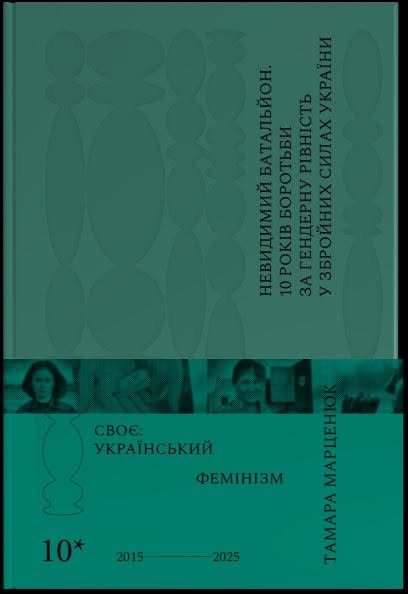
“The Invisible Battalion: 10 Years of Fighting for Gender Equality in the Armed Forces of Ukraine,” by Tamara Martsenyuk. What’s your first impression of this book? It’s all about visibility. It’s about how long a woman can be right in the thick of history’s most difficult events—fighting, rescuing, commanding, volunteering, documenting, changing the rules — and still remain “invisible” to some.
“The Invisible Battalion” is no longer just the name of a project. It’s a metaphor for an entire generation of women who didn’t wait to be allowed to be part of history. They simply stepped into it — in uniform, in body armor, with a camera, a laptop, research, the law, or their own voice.
Yes, I would very much like men to read this book. Not to convince them of anything or force them to “become feminists.” But simply so they can see what they might have overlooked. So that when they hear the phrase “female soldier,” they don’t see an exception, not the “weaker sex,” not someone’s desire to prove their worth, but a professional, a sister, a leader — a person who pays just as high a price for freedom. And perhaps, after reading this book, some people will feel a little uncomfortable recalling their own jokes about “women’s work,” “professions not suited for women,” or the idea that women supposedly have to prove themselves more than men.
The issue of women’s visibility in war is gradually ceasing to be something “extra” and is becoming an important part of Ukrainian reality. Because equality isn’t born of pretty words. Behind it are always real people, real stories, resistance, perseverance, and a great, great deal of work. These 23 interviews represent 23 voices, but behind them lie many more women who, over the years, have transformed the Ukrainian military and society’s very notion of who has the right to be strong, brave, professional, and responsible.
The whole world is now looking more closely at Ukraine. Here, women haven’t simply “been given the opportunity” to be part of the struggle — they have long been part of it. The history of Ukraine today is not being written solely by men’s voices. It is written by the hands, decisions, risks, and lives of women. Perhaps the most important lesson of this book isn’t even about gender. It’s about human dignity: when society stops dividing people into those who can and those who cannot, it becomes stronger. This is the hallmark of a mature, strong, and just society.
This book is a continuation of the series “SVOYE: Ukrainian Feminism,” which aims to highlight women’s contributions to the development of Ukraine and its democratic values.