
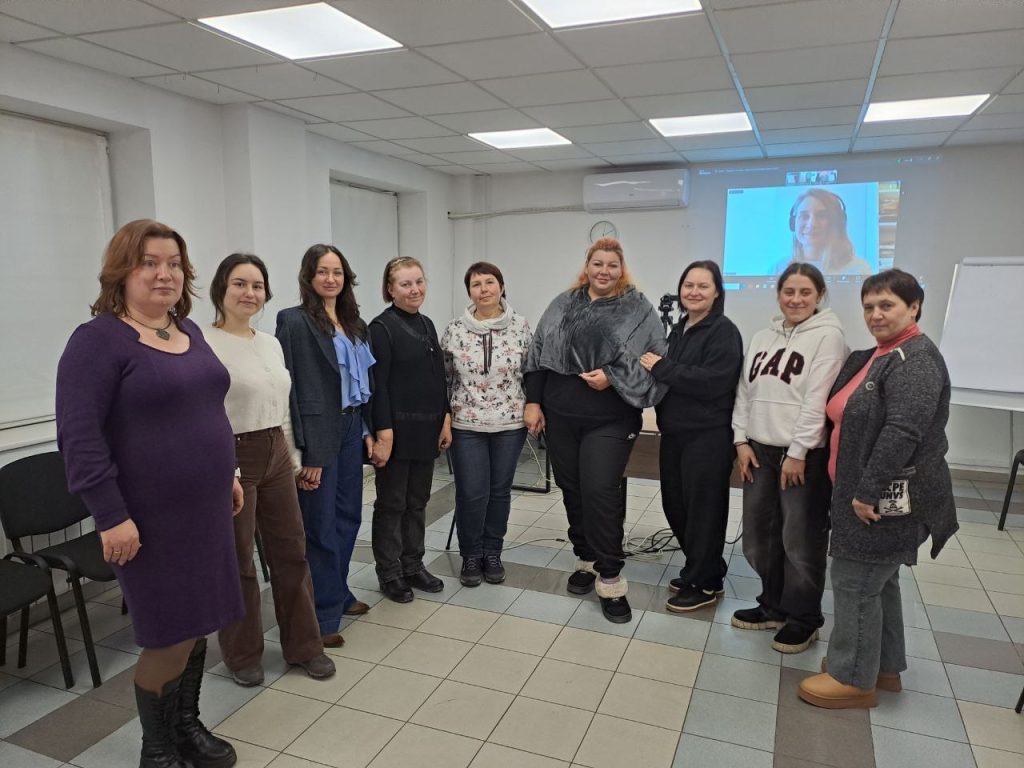
Today’s session of the training program “Resilience and Stability: Effective Communication Under Stress” focused on understanding the impact of traumatic events on a person’s psychological and emotional state and the quality of their interactions with others.
Participants explored how chronic stress and experiences of loss, where uncertainty and anxiety alter perceptions of reality, diminish the ability to listen and be heard, and provoke conflicts and emotional exhaustion. Recognizing these processes was an important step toward treating oneself and others with greater care, as well as toward fostering empathetic, supportive communication.
Special attention was given to the concept of “resilience” — a person’s inner capacity to adapt, recover from difficult events, and maintain vitality even in crisis situations.
Participants analyzed their own resources, sources of strength, and means of support that help not only withstand stress but also find meaning, support, and motivation to move forward. Understanding the mechanisms of resilience contributed to the development of a more conscious approach to one’s own well-being and psycho-emotional safety. It’s like turning PTSD into growth.
The practical portion of the training covered approaches to help participants take care of themselves and improve the quality of their communication under stressful conditions: self-regulation techniques, breathing exercises, methods for stabilizing emotional states, active listening, and nonviolent communication.
“These tools enabled participants to better recognize their own reactions, reduce stress levels, and build a more constructive dialogue even in difficult situations,” noted Natalia Stadnychuk, director of the NGO “Space for Positive Change” and trainer.
A significant portion of this part of the training was devoted to the topic of emotions and feelings, their role in verbal and nonverbal communication, as well as the development of emotional intelligence. Participants learned to recognize emotional signals, become aware of their impact on words, intonation, gestures, and facial expressions, and adjust their own reactions.
The development of emotional intelligence became a key factor in improving the quality of interaction, building trust, reducing conflict, and creating a safe, supportive communicative space.
And at the end of the training day, the participants, together with the trainer and Natalia Schaff, a representative of the German women’s organization AMICA e.V., formed a women’s circle and made a wish. We really hope it comes true, because it was a collective wish!